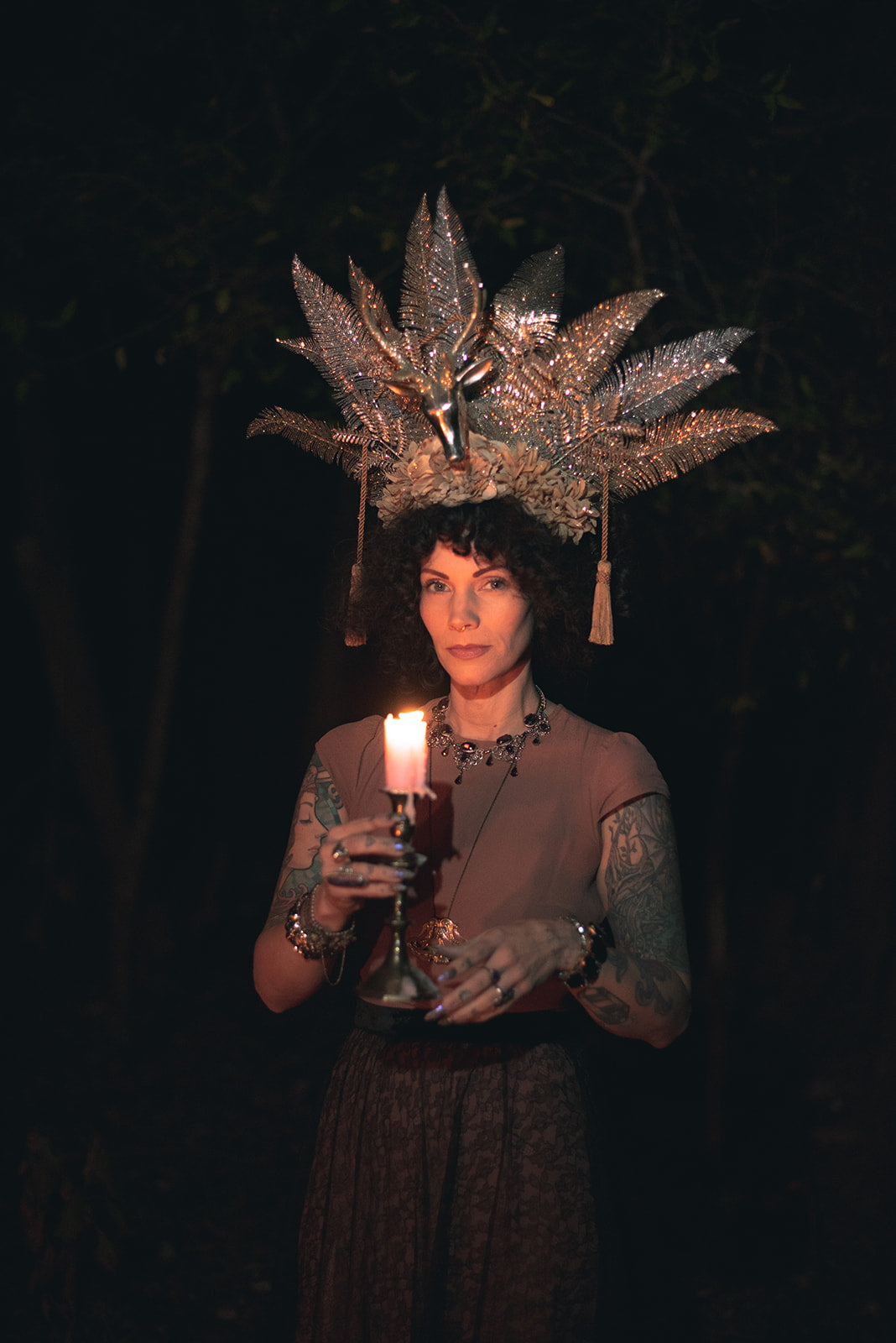


There was something undeniably witchy about the 1990s.
Maybe you remember celestial-print everything, velvet dresses, black chokers, mood rings, crystal pendants, incense drifting through bedrooms, and bookstores with entire shelves devoted to astrology, tarot, Wicca, and alternative spirituality.
Or maybe you weren't there for it the first time. Either way, you've probably seen its descendants.
Today, moons and stars are back on our walls. Crystals sit on bookshelves and desks. Tarot has found an enormous new audience. Cottagecore has us dreaming about herb gardens and old houses, while witchcore and whimsigoth have brought back the candles, jewel tones, celestial décor, flowing fabrics, and gloriously excessive sun-and-moon imagery of decades past. And right in the middle of this renewed fascination is Practical Magic 2.
So how did we get from the witch boom of the '90s to today's witchy trends? And what should all you know if all of this has sparked an interest in exploring witchcraft for yourself?
Well, put on some Stevie Nicks, find your favorite candle, and get comfy. We've got a few decades to cover in today's blog.
The ’90s Witchcraft Boom

It's tempting to remember the 1990s as one big supernatural montage of The Craft, Hocus Pocus, Sabrina the Teenage Witch, Buffy the Vampire Slayer, Charmed, and Practical Magic. But something more interesting was happening underneath the pop culture trends.
Wicca and other forms of contemporary Paganism were becoming increasingly visible, while books made information about these religions and practices more accessible to people outside the established groups. Academic histories of Wicca note the growth of self-initiation during this period, followed by the arrival of the internet as another avenue for learning and connecting with fellow witches. At the same time, popular culture became fascinated with witches, and all things witchy.
The Craft arrived in 1996. Sabrina the Teenage Witch premiered that year as well. Buffy the Vampire Slayer followed on television in 1997, and 1998 brought both Charmed and Practical Magic.
These weren't documentaries about real witchcraft—and they certainly shouldn't be treated as instruction manuals.
But they changed the image of the witch.
The witch could now be the girl sitting next to you in class. She could be your sister, your friend, your aunt, or the woman running the local shop filled with herbs and candles. She could be rebellious, funny, fashionable, romantic, angry, powerful, awkward, grieving, or searching for her place in the world.
And for some viewers, fictional witches became an invitation to ask a very real question:
What does witchcraft actually look like outside the movies?
We Have to Talk About The Craft & Practical Magic
 If we're discussing witchcraft in the 1990s, there's no getting around The Craft.
Released in 1996, the film follows four teenage girls whose exploration of witchcraft becomes intertwined with friendship, identity, trauma, desire, power, and eventually the consequences of using that power irresponsibly.
Its influence on the visual language of the '90s witch is hard to miss: dark lipstick, school uniforms transformed into alternative fashion, candles, ritual circles, chokers, layered jewelry, and four friends who look like they could either cast a spell or introduce you to a very good band.
But there's an interesting piece of history behind all that Hollywood drama. The production hired practicing Wiccan Pat Devin as a technical adviser. She helped with elements such as the film's incantations and its treatment of Wiccan material. That doesn't make The Craft an accurate representation of Wicca (or witchcraft generally.) It remains supernatural fiction.
It does, however, illustrate the curious relationship developing between real-world spiritual practices and the fictional witchcraft being consumed by mainstream audiences.
And there's an important distinction here for anyone discovering this world today:
Wicca and witchcraft are not synonyms.
Wicca is a modern Pagan religion with its own history, traditions, beliefs, and ritual practices. Witchcraft is a much broader term. People may practice forms of witchcraft within various religious or spiritual frameworks—or without identifying with a religion at all. Likewise, Paganism, occultism, folk traditions, divination, astrology, and witchcraft overlap in some places, but they aren't interchangeable labels.
Learning those differences is one of the best places for a beginner to start.
Curious? Start With a Book
The internet can introduce you to thousands of ideas before breakfast. That doesn't necessarily mean it can provide context for them. Books give you room to slow down and understand where a practice came from, who practiced it, and how different traditions approach similar subjects.
Depending on your interests, you might begin with books about:
 |
 Folk Lore
| SHOP ALL BOOKS |
And remember: being a beginner isn't something you need to rush through. Learning why people do something is often far more valuable than memorizing what you're supposedly "supposed" to do.
Then Witchcraft Got Cozy
Two years after The Craft, audiences met another kind of fictional witch.
Sally and Gillian Owens weren't teenagers discovering supernatural abilities at school. They were sisters from a family of witches, navigating relationships, grief, family history, motherhood, and the consequences of a curse woven through generations. Based on Alice Hoffman's 1995 novel, Practical Magic arrived in theaters in 1998.
And aesthetically? It gave us the house. You know the one.
The sprawling Owens home. The kitchen. The garden. Bottles and jars. Candles burning against old wood. Herbs hanging around the house. Aunt Jet and Aunt Frances being the relatives many of us would still happily move in with tomorrow. But underneath the enviable kitchen and gorgeous coastal scenery, Practical Magic offered something deeper. Its witchcraft was connected to family.
The story revolved around sisters, daughters, aunts, ancestors, inherited burdens, romantic relationships, grief, and the bonds women form with one another. That helps explain why the movie feels so compatible with today's witchy culture. For all its supernatural elements, Practical Magic makes enchantment feel domestic and cozy. It exists in kitchens and gardens. It's handed down through generations and connects us to our ancestors. It lives alongside heartbreak, pancakes, family arguments, relationships, and ordinary responsibilities.
And, of course, we can't discuss Practical Magic without mentioning Midnight Margaritas.
The scene has become one of the movie's most beloved moments because it captures something that discussions of witchcraft sometimes overlook: joy matters, too. Not every meaningful practice has to happen alone in silence.
Community, celebration, music, food, laughter, friendship, and family have always played roles in religious and spiritual life across cultures.
You don't need a perfectly styled altar (or an Owens family grimoire) to create meaningful rituals around the people you love.
|
|
 Shop Merch
 Stationery
 Quotable Accessories
| SHOP OUR PRACTICAL MAGIC COLLECTION |
Meet the Descendants of the ’90s Witch
 Social media has given us wonderfully specific names for aesthetics we previously struggled to describe. Some of those aesthetics have become closely associated with witchcraft.
But aesthetics and spiritual practices aren't the same thing, so let's untangle a few.
What Is Witchcore?
Witchcore is an aesthetic built around imagery associated with witches, occultism, folklore, divination, and nature. It can include candles, tarot decks, grimoires, and celestial accessories.
Keep this in mind, however, loving the aesthetic doesn't automatically make someone a witch.
Likewise, practicing witchcraft does not require you to dress in black, own a collection of antique candlesticks, or transform your living room into an apothecary. You can practice witchcraft while wearing yoga pants and reheating leftovers. We promise!
What Is Whimsigoth?
If you've recently found yourself wanting velvet curtains, celestial wall hangings, stained glass lamps, silver jewelry, and enough moons and stars to open your own planetarium, welcome to whimsigoth.
The term itself is contemporary, but it describes an aesthetic strongly associated with the late 1980s and 1990s. Modern discussions of whimsigoth consistently connect it with celestial imagery, rich colors, layered textures, bohemian influences, and the moody-but-playful interiors and fashion of that period. In other words, we eventually invented a word for that thing the '90s were already doing.
And Practical Magic fits beautifully into our modern understanding of it. So does The Craft.
So do celestial sun-and-moon decorations, crushed velvet, silver rings, tarot imagery, dark florals, flowing skirts, candles, and the sort of décor that makes you wonder whether the person living there owns a crystal ball.
What Is Cottagecore?
Cottagecore occupies a slightly different corner of this world. It romanticizes rural and domestic life: gardens, baking, wildflowers, handmade crafts, old cottages, seasonal living, simple pleasures, and a closer relationship with nature. That naturally overlaps with some forms of contemporary witchcraft, particularly practices involving seasonal observance, gardening, herbs, plants, folk traditions, and nature.
But once again: just because it’s witchcore, whimsigoth, or cottagecore doesn’t mean its witchcraft. You can grow rosemary without casting a spell over it. You can bake bread because bread is, well, delicious. And you can love Practical Magic because you desperately want that kitchen. To put it simply, cottagecore is just about the vibes.
Speaking of ’90s Accessories... Remember Mood Rings?
Yes. Mood rings!
Few objects capture the wonderfully weird spiritual-adjacent retail culture of the '90s quite like them. The concept is older than the decade, but mood rings enjoyed renewed popularity during the broader '90s fascination with color-changing jewelry and mystical accessories. These thermochromic liquid crystal rings are fun and meet your nostalgic needs, perfectly! If you remember wearing one while flipping through a book about your zodiac sign, congratulations: your '90s credentials have been verified.
| SHOP MOOD RINGS → |
 |
However, Witchcraft Isn't An Aesthetic...

Here's something we don't talk about enough when discussing witchy aesthetics:
Not everybody lives in a misty forest in New England. We can be witchy anywhere in the world. And when social media starts serving autumn rituals involving wool sweaters, roaring fireplaces, and crisp October mornings while it's still 90 degrees outside...well. Bless its heart.
Your spiritual practice doesn't need to resemble someone else's climate, landscape, or Pinterest board. For us, here in Texas, connecting with the natural world might mean noticing a dramatic thunderstorm rolling across the horizon, or paying attention to the changing behavior of birds. This principle applies wherever you live. Just pay attention to your environment.
One of the simplest practices a beginner witch can adopt costs absolutely nothing: just go outside regularly and observe what's changing. What's blooming? What's disappearing? When does the light begin changing? What does the moon look like tonight? Which birds are suddenly everywhere? When does the air finally feel different?
A spiritual relationship with nature becomes much more meaningful when we're experiencing nature as it actually exists around us, and not trying to recreate somebody else's landscape.
Inspired by the Aesthetic? Here's How to Explore Actual Witchcraft Practices
Maybe you came here because you watched Practical Magic again. Maybe your whimsigoth algorithm has gotten completely out of control. Maybe you wandered into a metaphysical shop because you thought the crystals were pretty and emerged 45 minutes later wondering what a pendulum is. Whatever it is, welcome! Curiosity is a perfectly reasonable place to begin. But here's something we wish more beginners were told: you don’t need to buy everything!
Start with learning. Read. Ask questions. Journal. Spend time outdoors. Learn the history behind the things you're interested in. Then choose tools because they're useful or meaningful to your practice, not because someone told you that every witch is required to own them.
Four Simple Ways to Start Exploring Witchcraft
Now that we have all of that covered, are you curious about where to start? Let’s move beyond the aesthetic and begin to explore actual practices, keeping it simple!
1. Read Before You Practice
We're putting this first for a reason. Books help provide context that short-form social content often can't. Choose one subject that genuinely interests you and follow it. Maybe that's tarot. Maybe it's the history of witchcraft. Maybe it's Wicca, Paganism, astrology, herbs, candle work, folklore, or crystals.
You don't have to decide what kind of practitioner you are before you've even learned what's out there.
| BROWSE OUR BOOK COLLECTION → |

2. Wear Your Intention
Objects can become useful reminders of intentions. That's one reason jewelry fits so naturally into personal spiritual practices. A beaded bracelet made with stones traditionally associated with qualities such as grounding, confidence, love, protection, or calm can become a physical reminder of what you're working toward.
The important distinction is that crystals shouldn't be presented as guaranteed cures or supernatural vending machines. Instead, learn the historical, cultural, and contemporary associations people have given different stones, then decide what those symbols mean within your own practice.
| SHOP CRYSTAL BRACELETS → |

3. Try Simple Candle Work
Candles appear in an enormous range of religious, ceremonial, and spiritual traditions. Within various forms of contemporary witchcraft, candles may be used during meditation, intention-setting, spellwork, prayer, or ritual.
For a beginner, that can be incredibly simple. Choose an intention. Write it in your journal. Light your candle. Spend a few quiet minutes thinking about what that intention actually requires from you. If your intention is confidence, for example, don't stop at wishing to feel confident. Ask yourself questions like, what's making me hesitate, or what would I do differently if I trusted myself? That's where ritual can become a useful a way of focusing your attention before taking it.
Remember to be safe! Never leave a burning candle unattended, and keep it away from pets, children, fabrics, dried herbs, and other flammable materials. Always follow the manufacturer's burning instructions.
| EXPLORE RITUAL CRYSTALS→ |
 |
4. Keep a Journal of What You're Learning
You don't need a centuries-old family grimoire discovered in the attic. A notebook will do. Use it to record the books you've read, your tarot readings, dreams, seasonal or moon observations, rituals you've tried, personal reflections, or research on herbs, crystals, and practices.
| SHOP JOURNALS & GRIMOIRES→ |
 |
Welcome Back, Witches
Maybe The Craft sent you searching for books about Wicca in the '90s. Maybe you're awaiting Practical Magic 2. Maybe you once owned six mood rings, and Charmed was our whole personality. Or, none of that applies to you because you've justs discovered this world recently.
The point is, an aesthetic can spark curiosity. A movie can inspire. The interesting part is what happens after you're curious. Ask questions. Learn about the history and experiment thoughtfully. Keep what feels meaningful and continue learning. And yes, have some fun with it! Wear the mood ring. Stack the beaded bracelets. Fill your shelves with books, and light a candle.
You don't need to match the aesthetic to create rituals that make your own home feel a little more intentional.
 |
 Divination Tools
| SHOP OUR ENTIRE METAPHYSICAL COLLECTION |


